
Monitor
View conversation logs in real-time.
With Inconvo you can easily monitor your users’ conversations with your agents.
Conversations
Section titled “Conversations”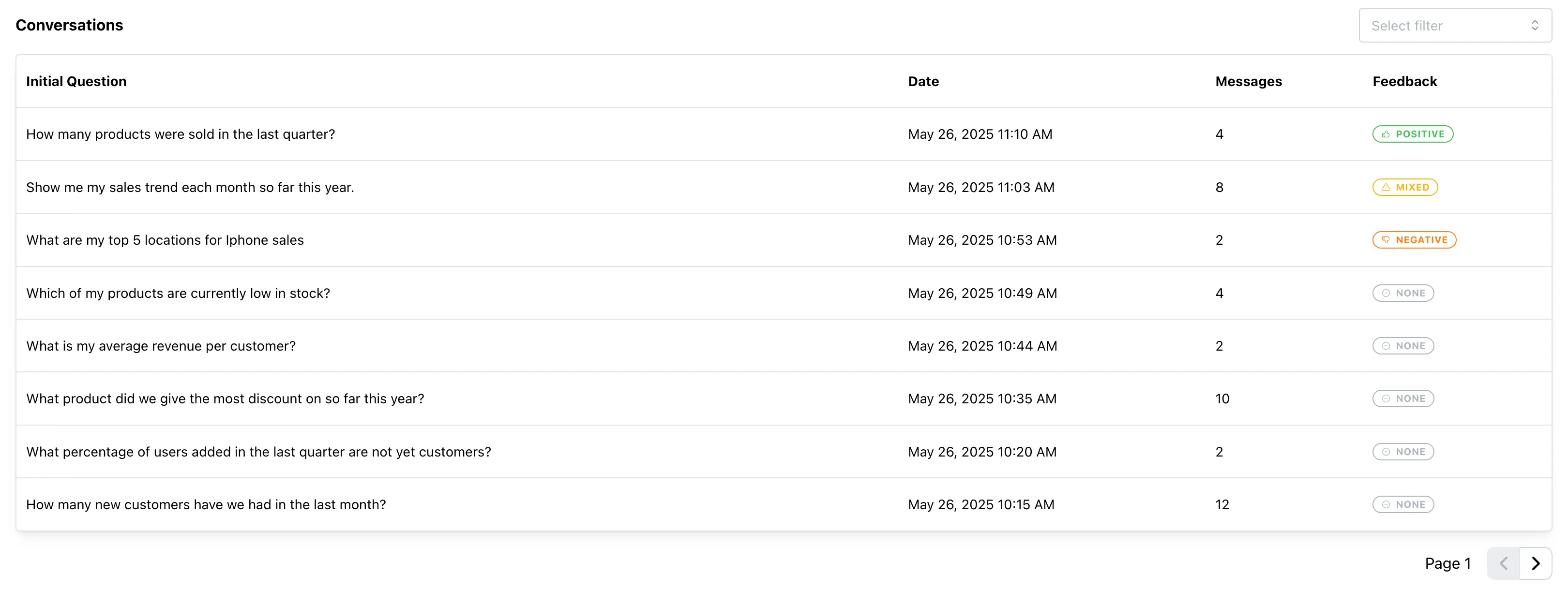
Every conversation created through the API will be visible in the conversations table.
Conversation Feedback
Section titled “Conversation Feedback”Conversations containing answers with feedback are given a feedback rating of Positive, Mixed or Negative.
Feedback Rating Ranges:
- Positive:
averageFeedback >= 0.6(60% or higher) - Negative:
averageFeedback <= 0.3(30% or lower) - Mixed:
0.3 < averageFeedback < 0.6(between 30% and 60%)
Examples:
- Conversation with all positive feedback:
avg = 1.0→ Positive - Conversation with all negative feedback:
avg = 0.0→ Negative - Conversation with 2 positive, 1 negative:
avg = (1+1+0)/3 = 0.67→ Positive - Conversation with 1 positive, 1 negative:
avg = (1+0)/2 = 0.5→ Mixed
Filtering Conversations
Section titled “Filtering Conversations”Conversations can be filtered by feedback type:
Negative Feedback: Shows conversations containing at least one answer with negative feedback.Positive Feedback: Shows conversations containing at least one answer with positive feedback.
Conversation Details
Section titled “Conversation Details”Clicking on row within the conversations table allows you to view the details of a particular conversation.
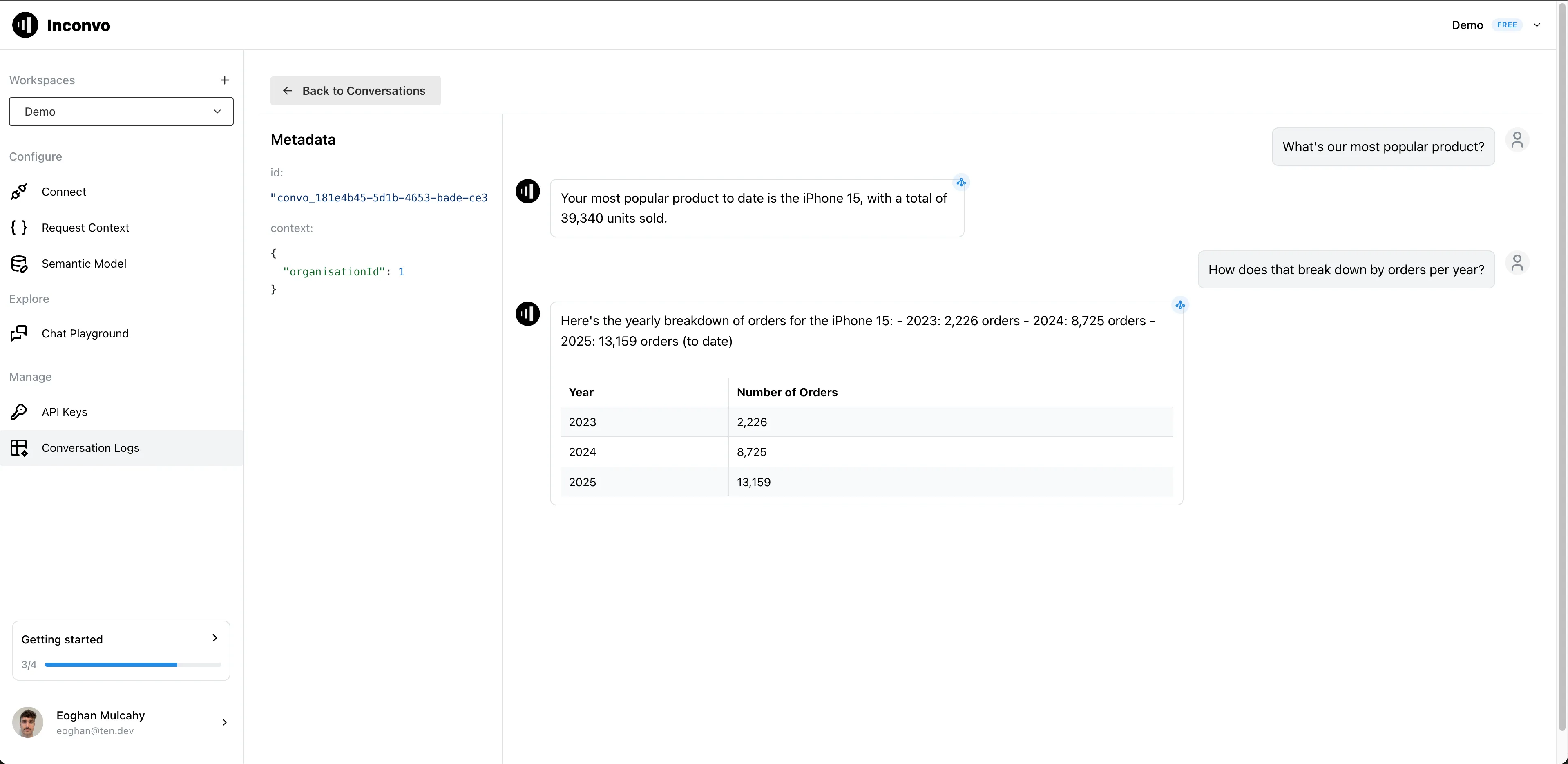
Click the trace button on any response to view the steps your agent took to generate it.
Debugging with Traces
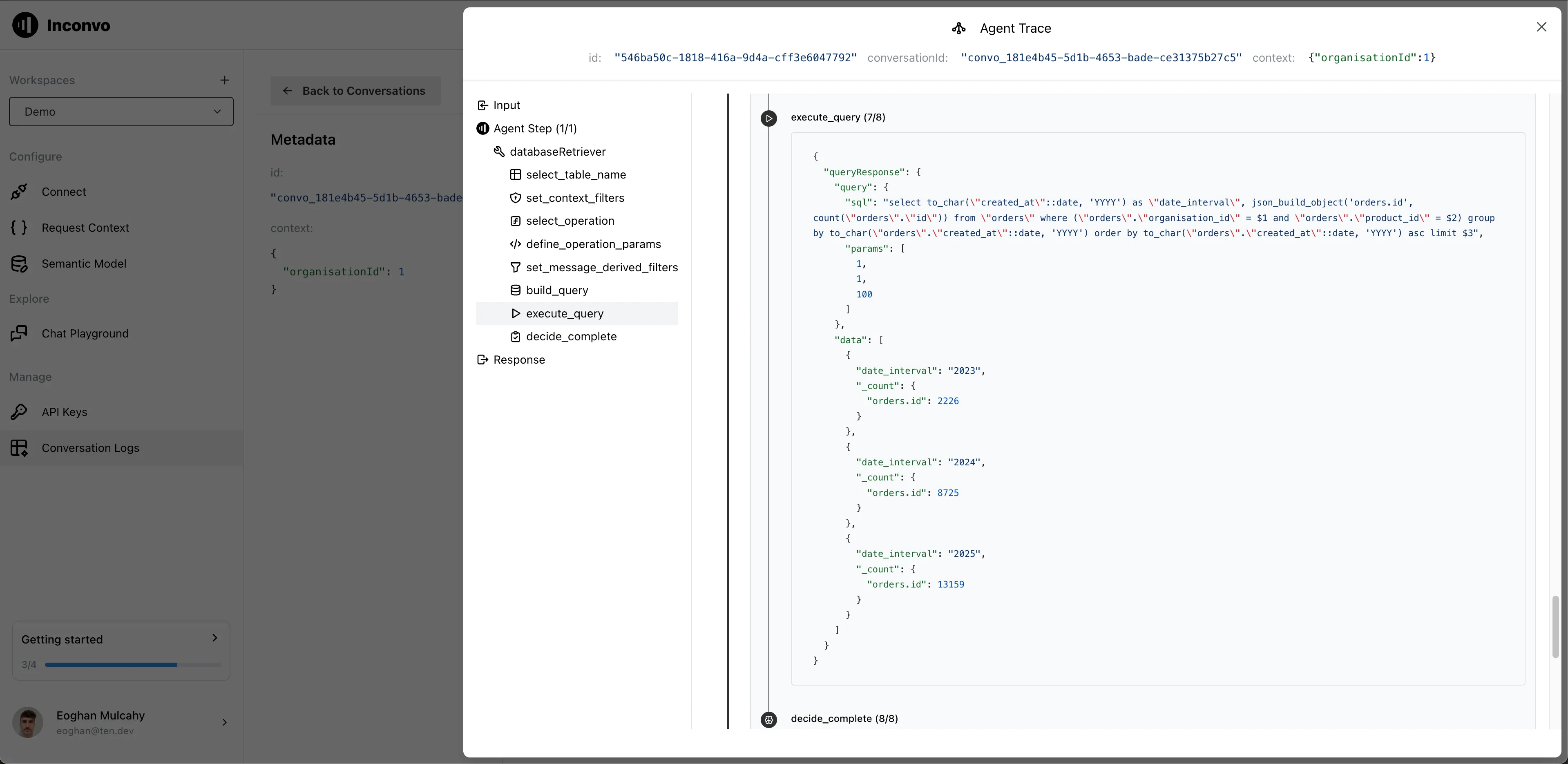
Section titled “Debugging with Traces”Traces show every step your agent took to generate a response — the tools it called, the queries it ran, and the data it returned. When a response is incorrect, traces help you identify the root cause.
Common patterns
Section titled “Common patterns”| Pattern | What you see in the trace | Fix |
|---|---|---|
| Wrong table | Agent queries users instead of customers | Add a table prompt clarifying terminology |
| Missing filter | Query returns data across all tenants | Add a context filter on the table |
| Ambiguous column | Agent picks created_at instead of last_order_at | Add a table prompt explaining which column to use for the concept |
| Wrong join | Agent joins through an unrelated table | Toggle the incorrect relation to Off |
Walkthrough
Section titled “Walkthrough”- Open a conversation from the monitoring table
- Click the Trace button on the response you want to debug
- Review the tool calls — check which tables and columns were selected
- If the query is wrong, go to your semantic model and add context (table prompts, computed columns, or relation changes)
- Re-run the query to confirm the fix
Feedback Loop
Section titled “Feedback Loop”Combine monitoring with the feedback API to continuously improve agent quality:
- Collect feedback — Use the feedback API to log
positiveornegativeratings on responses from your users - Filter by feedback — Use the monitoring table to filter conversations with negative feedback
- Debug with traces — Open traces on negative responses to identify what went wrong
- Fix the semantic model — Update table prompts, context filters, or relations as needed
- Validate — Re-run failing queries to confirm they now return the correct results